sexta-feira, 12 de setembro de 2014

Best Paintings of all time

I can't just don't add 'Las Meninas' by Diego Velazquez (1599-1660) in such a list. This is the famous and curious case of a painting of a painter painting a painting, which is the artist himself that is pictured painting a painting that nobody could tell for sure about what it is. Confused? Las Meninas or the 'Maid of Honour' has been labeled as the 'Theology of Painting' because of the complex interplay between perspective and illusion. Spanish identity, royal succession, family history. What is Velazquez painting? A question that continues to perplex the art world.

Also the fact that who his self-portrait is most likely painting in the painting (the royal couple) is so barely noticeable, and the fact that he apparently is looking straight at us, gives this sensation that we are the subject of his painting. In resume, it has so many levels, that you can never fully grasp it, for the changing of meaning seems to never end. I bet that surrealist Magritte loved this one.


domingo, 24 de agosto de 2014

Best Paintings of all time

Never before or after did Leonardo da Vinci (1452-1519) used his technique of sfumato so well like in his painting 'Salvatore Mundi'. The slightly fogged portrait of Christ looks ethereal, phantasmagoric, and looking at it staring back at you, feels almost like a supernatural experience. That was his intention, and well, he achieved 100%. I guess this is my first favorite of Da Vinci, but then, this one is really something. It almost looks to good to be real. Truly a masterpiece from an artistic genious.


terça-feira, 12 de agosto de 2014

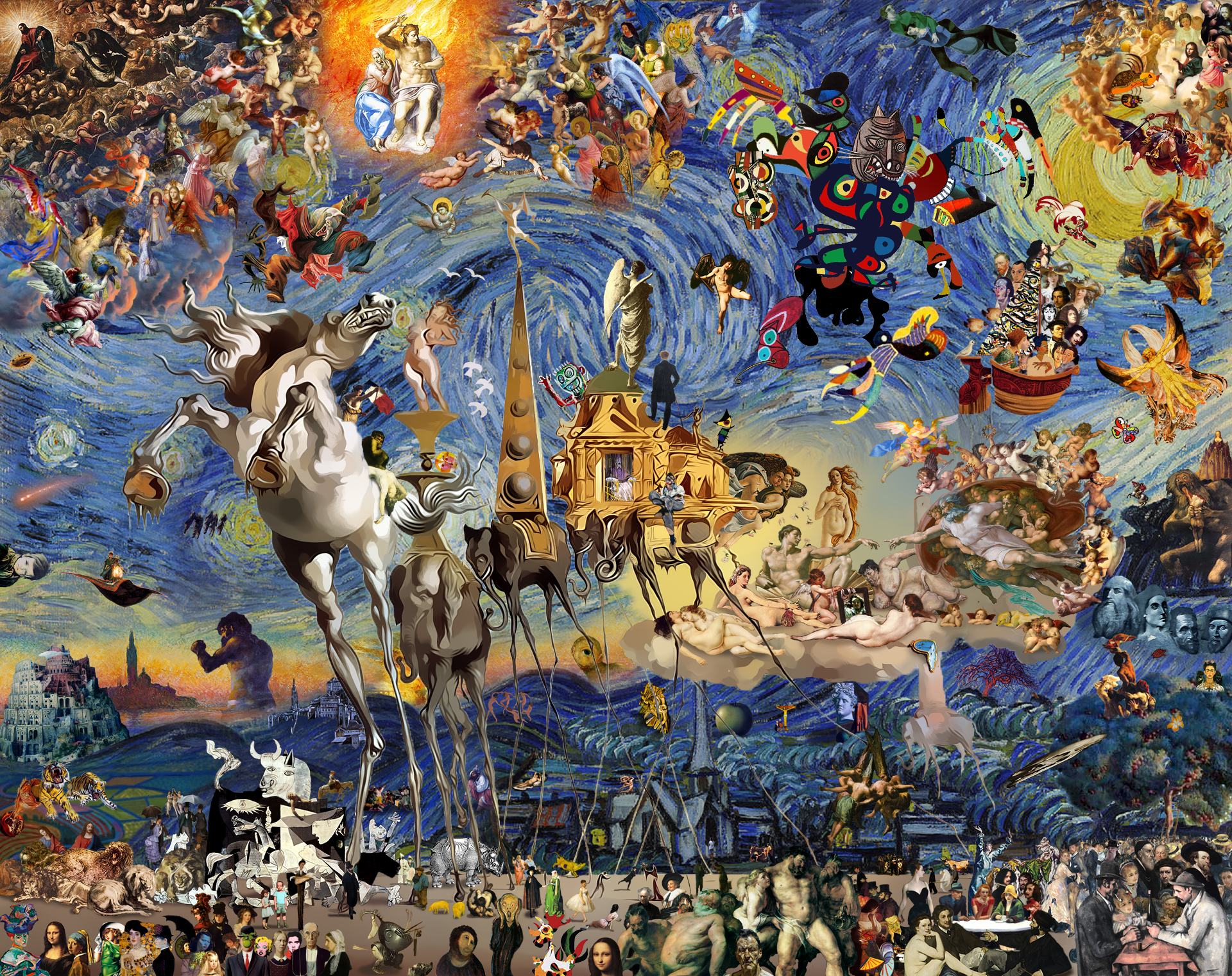
My artwork

This is my school artwork about famous painters in which I decided to include as many painters portraits as I could  or else their most famous paintings.


quarta-feira, 25 de junho de 2014

Best Paintings of all time

John Singer Sargent's (1856-1925) 'El Jaleo' is an almost 12 feet wide loosely desaturated painting with a fantastic composition and a great sense of movement not very common in other Sargent's works. It's like if the dancer is about to do one of those energetic flamenco dancing moves. The absence of a barrier between the viewer and the dancer makes for an illusion that we are present at the event. The lightning effect helps to create this sensation, as if the viewer is somehow the source of the light that illuminates all the painting. It's somehow reminiscent of the "stage ballerina's" of Degas which Sargent probably admired and it's definitely a favorite of mine.

sábado, 21 de junho de 2014

Best Paintings of all time

The painting 'Applicants for Admission to a Casual Ward', by Sir Luke Fildes (1843-1927) is a very interesting painting to me for many reasons. The use of the light projected to the building enhancing the bunch of poor people leaning against it, is quite good. And if you pay close attention, you'll see that the painting depicts homeless people from different social classes in a row waiting for something, probably shelter for the night. It was painted by a victorian painter in 1874, but it totally reminds me of a scene from the Great Depression from 1929. To think that it was originally created as a print in some magazine, and intended only to gain sympathy and to create a feeling of social conscience from the readers, speaks volumes of the skills of the painter.


His other painting that I put here is a very touching painting named 'The Widower' that depicts a father's desperation facing the challenges of being extremely poor and a widower at the same time. He is crying holding one of his five children who is aparently very sick. The oldest daughter seems to be thinking, to no avail, in a way she can help her father. The whole dramatic scene is enhanced by all the little details like the very poor house, the grimy and old clothes of the father, and one of the children seems to be starving and trying to find food in his empty bowl. No one can deny that it's a very emotional and heartbreaking painting.

quinta-feira, 19 de junho de 2014

Best Paintings of all time

Carl Lemoch or Kirill Vikentevich Lemokh (1841-1910), a realist russian painter, painted this work that I consider a favorite of mine, for no other reason than what it represents. A very endearing woman (presumably not the mother) is presenting this adorable little girl to the newborn sibling, while the rest of the "flock" awaits for their turn to see it. The cute girl is a little shy and confuse and is grabbing the woman's dress trying to hide from what she's seeing like kids normally reacts in such a situation. The poor house and family, the resting mother in the back, the lovely woman and the innocent look in the toddlers eyes, all adds to this beautiful painting named 'New acquaintance'.


 The next one is a work by the almost unknown german painter Ludwing Seitz (1844–1908). While in the Vatican, there are a lot more things to see there than the Sistine Chapel. The hallways of the Museum is known for being filled all around with beautiful paintings and it never fails to impress the visitors. This particular fresco by Seitz, one of the few he painted there, is my favorite. The angel seems like 3d painted.

quarta-feira, 18 de junho de 2014

Copies of Famous Paintings

It is a well known fact that Peter Paul Rubens (1577-1640) was very influenced by Michelangelo (1475-1564) since his trip to Italy in his youth. It helped define his style of very muscular figures, but on the average, Rubens was a little better with body proportions, and his paintings of women are a lot softer and curvy, if not a little fat, in comparison to the big muscled and hard looking bodies of Michelangelo's women. Both were geniuses of course, and it was much easier for Rubens to learn studying paintings of masters like Michelangelo whereas Michelangelo pretty much didn't have anyone before him painting muscular bodies for him to study. Rubens study of 'The Creation of Adam' originally by Michelangelo, is great for us to see the similarities and differences of these two masters. The even more muscular body of God and the fiercer look in his eyes in Rubens copy is a nice detail to notice. So here it is, the original and the copy respectively.